Biography
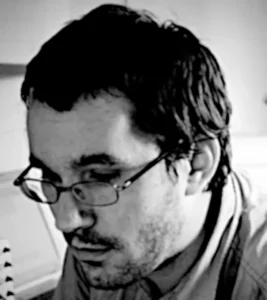
Biography. Born in 1978, Romuald BOUCHERON began playing music at the age of four, starting with the accordion. He continued his musical training in the classes of Dominique VOISIN and Catherine DESMARETS. He then joined Roland CREUSE’s class at the Orléans Conservatory and graduated with a first prize in musical training at the age of just 15. He completed his training with courses in composition, first with Roland CREUSE (“his dear teacher”), then with Alain BERNAUD (who won first prize in the Prix de Rome in 1957 and was professor of harmony at the CNSMDP). Having completed his studies in composition, harmony, counterpoint, and orchestration before the age of 18 and obtaining his high school diploma, he then pursued scientific studies for several years, earning a doctorate in acoustics in 2004.
The beginnings of his training
From an early age, he was drawn to music, which he first discovered through accordion records [a sapphire on the mantelpiece and off he went!]. This fascination prompted him to ask his parents if he could learn to play music. Family lore has it that he learned to read at around the age of four for the sole purpose of being able to decipher the names of the notes that André ALLAIRE, a great local accordionist, scrupulously marked under each of the notes on the scores he wanted him to play.
A classic and fast course
He enrolled at the Cléry-St-André music school fairly quickly to study music theory and the oboe with Dominique Voisin. He soon joined the municipal wind orchestra and took part in numerous concerts, discovering the vast repertoire available for this type of ensemble. Three years later, he entered the Orléans’ Conservatory, where he studied with Catherine Desmaret and then Roland Creuse, his first teacher. At the same time, he took classes with Fernand Eché, Jean-Marie Poupelin, and Catherine Hérot-Darves in oboe and earned his gold medal. His first musical shock came when he participated as an oboist (more specifically on the English horn) in his first rehearsal with a symphony orchestra (Ravel’s L’Heure Espagnole).
‘
Composer as a matter of course
He has been composing music since his early years. His music is distinguished by an often daring and deeply personal approach. A great lover of beautiful French orchestrations, he himself claims to be influenced by the great classics of the early 20th century (Debussy, Ravel, Bartok, Stravinsky, and Varèse). Many of his pieces reveal complex and dreamlike soundscapes, sometimes quite classical and modal, and others very contemporary.
His love of French music (particularly the specific characteristics of the French orchestra) comes from composers whose influence he feels, such as Messiaen, Poulenc, but also Françaix, Dutilleux, Ibert, Sancan, Boulez and Jarrell, in very different styles.
His career as a composer began in earnest at the end of the last millennium: in 1996, he composed the music for Nicolas Périgois’ first short film (La Mort Marraine), which was selected for the Cannes Short Film Festival. The music for this short film, which attracted attention at several festivals, won first prize for short film music in Bourges. That was the start.
He then composed regularly for short films and shows for various companies. Ensembles and orchestras regularly commissioned works from him to enrich their repertoire.